
If you are running digital campaigns for a real estate project, one question comes up almost every day:
“How much does a real estate lead cost?”
It sounds like a simple question, but there is no single answer.
A lead for a ₹60 lakh apartment, a ₹3 crore luxury residence, and a commercial property can have completely different costs. Even two projects in the same location can produce very different results.
This is why looking only at cost per lead (CPL) can be misleading.
A campaign that generates leads at ₹150 may look better than one generating leads at ₹500. But if the ₹500 leads are genuinely interested buyers who answer calls and visit the project, while the ₹150 leads are mostly unresponsive, the cheaper campaign may actually be wasting more money.
For developers and real estate marketers in Noida, Greater Noida, Gurgaon and Delhi NCR, the better approach is to measure the entire journey:
In this guide, we will explain how real estate lead generation cost works, what affects it, which numbers you should track, and how to improve lead quality without simply cutting your advertising budget.
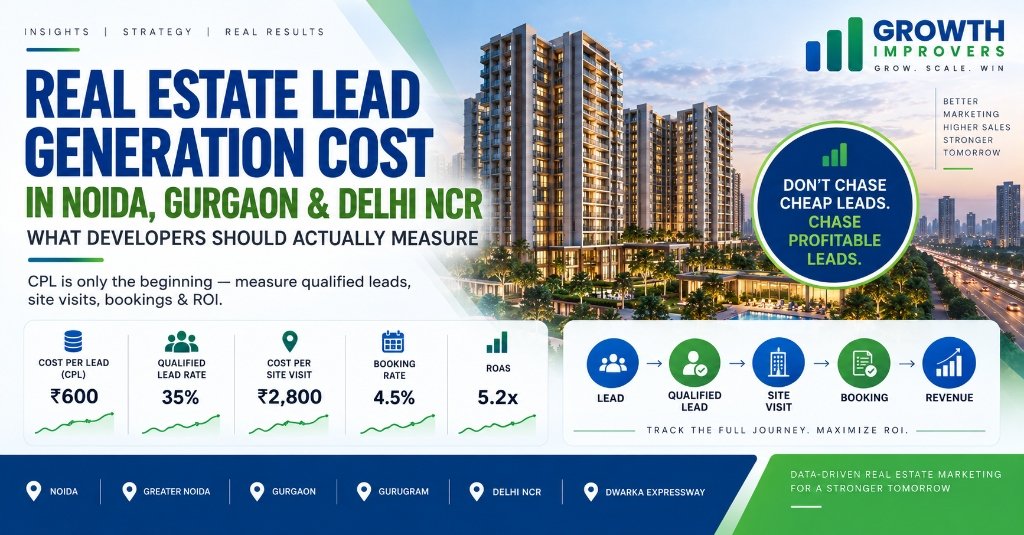
Don't chase cheap leads. Chase profitable leads. A ₹100 CPL campaign with 7% qualification produces a ₹5,000 Cost Per Site Visit, while a ₹200 CPL campaign with 28% qualification drops your Cost Per Site Visit to ₹1,785—cutting acquisition costs by 64%!
What Is Real Estate Lead Generation Cost?
Real estate lead generation cost is the amount a business spends to generate enquiries from potential property buyers.
The simplest calculation is:
For example, suppose a project spends ₹50,000 on Meta Ads and generates 250 leads:
₹50,000 ÷ 250 = ₹200 per lead. So the campaign's CPL is ₹200.
But that number alone does not tell you whether the campaign is successful.
Imagine that only 40 of those 250 leads are relevant and interested. The more useful number becomes:
This is why developers should not judge a campaign only by the vanity number shown inside Meta Ads Manager or Google Ads.
Why a Low CPL Does Not Always Mean a Good Campaign
One of the most common mistakes in real estate advertising is trying to reduce CPL at any cost. A lower CPL is useful only when the leads have reasonable quality.
For example, compare two campaigns with identical ₹50,000 budgets:
| Campaign | Spend | Leads | CPL | Qualified Leads | Cost / Qual. Lead |
|---|---|---|---|---|---|
| Campaign A | ₹50,000 | 500 | ₹100 | 35 | ₹1,428 |
| Campaign B | ₹50,000 | 250 | ₹200 | 70 | ₹714 |
Campaign A looks better if you only look at CPL (₹100 vs ₹200). But Campaign B generated twice as many qualified leads at half the acquisition cost per buyer!
This is why your marketing team should consistently evaluate:
- How many leads were generated?
- How many leads were relevant?
- How many answered the call?
- How many showed genuine interest?
- How many requested project details?
- How many booked a site visit?
- How many actually visited?
- How many eventually moved into serious sales discussions?
- What was the final cost per site visit?
- What was the final cost per booking?
These numbers provide a much clearer commercial picture than raw click dashboards.
What Is the Average Cost Per Real Estate Lead?
There is no universal average CPL that applies to every real estate campaign.
You may see agencies or marketers publish fixed figures such as ₹100, ₹200, ₹500 or ₹1,000 per lead. These figures can be useful as rough examples, but they should not be treated as industry rules.
Real estate lead generation cost depends on several factors. The most important ones include:
1. Property Price
A project selling homes at ₹70 lakh will generally have a different audience from a project selling ₹4 crore residences. Higher-ticket projects usually require more trust, stronger positioning, and more consideration before a buyer submits an enquiry.
2. Location
The cost of reaching property buyers changes from one market to another. Noida, Greater Noida, Gurgaon, Gurugram, Delhi and surrounding areas all have different buyer profiles and levels of competition.
3. Project Type
Residential apartments, plots, farm land, commercial shops, office spaces and luxury residences attract different audiences. A commercial investment campaign should not be judged using the same expectations as a mass-market residential campaign.
4. Target Audience
A broad audience can produce a large number of enquiries. A carefully defined audience may produce fewer enquiries but better sales opportunities.
5. Advertising Platform
Meta Ads and Google Ads work differently. Meta can create demand by showing a project to people based on audience signals and behaviour. Google Search can capture people who are already actively searching for a property, location or project-related term. Neither platform is automatically cheaper or better for every project.
6. Creative Quality
The advertisement is often the first thing a potential buyer sees. Poor images, unclear pricing, weak headlines or misleading offers can attract the wrong people.
A good creative should quickly communicate:
- What is being offered
- Where it is located
- Property type
- Key benefit
- Price or starting price where appropriate
- A clear next step
Real Estate Lead Generation Cost Across NCR Micro-Markets
Real Estate Lead Generation Cost in Noida
Noida has a wide range of residential and commercial property options, from relatively accessible apartments to premium and luxury developments along the Noida-Greater Noida Expressway and Sector 150.
This makes audience selection particularly important. For example, a campaign for a premium residential project should not simply target everyone interested in “property in Noida.” A better strategy considers:
- Property budget
- Preferred unit size (2 BHK, 3 BHK, 4 BHK)
- Location preference
- Buyer intent (End-user vs investor)
- Existing property ownership
- Job or business location (IT hubs, MNC corridors)
- Preferred possession timeline
- Whether the likely buyer is already living in Delhi NCR or migrating from another city
Real Estate Lead Generation Cost in Greater Noida
Greater Noida is a different market from central Noida, even though the two locations are closely connected. Projects here appeal to first-time buyers, investors, families looking for larger homes, and buyers looking for newer developments.
A campaign therefore needs to make the project's location and value proposition crystal clear. Instead of simply saying:
“Book Your Dream Home in Greater Noida”
The advertisement should communicate specific details such as:
- Exact sector (e.g. Sector 1, Greater Noida West)
- Apartment configuration
- Starting price
- Project size and density
- Major connectivity points (Metro, Expressways)
- Key lifestyle amenities
- Possession status, if applicable
The more clearly an advertisement sets expectations, the less likely it is to attract people who are completely outside the project's price or location range.
Real Estate Lead Generation Cost in Gurgaon
Gurgaon (Gurugram) has a very different buyer profile across its various micro-markets. A buyer looking for a property around Dwarka Expressway may have different priorities from someone looking on Golf Course Road, New Gurgaon, or Sohna Road.
For this reason, location-specific advertising is vastly more effective than treating the entire Gurgaon market as one audience:
- End-user messaging: Focus on connectivity, schools, offices, lifestyle, amenities and daily convenience.
- Investor messaging: Focus on project fundamentals, location, rental demand where supportable, development activity and long-term capital appreciation without making guaranteed return claims.
- Luxury buyer messaging: Focus more on architecture, privacy, specifications, experience, brand reputation and quality rather than simply discounting the property.
What Is Cost Per Qualified Lead?
Cost per qualified lead is often much more useful than basic CPL.
Suppose: Ad spend = ₹1,00,000 | Total leads = 500 | Qualified leads = 100
The CPL is: ₹1,00,000 ÷ 500 = ₹200
But the cost per qualified lead is: ₹1,00,000 ÷ 100 = ₹1,000
A qualified lead should be defined before the campaign starts. For example, a qualified lead may need to:
- Match the project's location
- Have a realistic budget
- Be interested in the correct property type
- Have a reasonable purchase timeline (0 to 90 days)
- Be reachable by phone
- Show genuine interest in the project
Learn more about structuring lead qualification systems in our guide on how to generate qualified real estate leads in Noida, Gurgaon & Delhi NCR.
Cost Per Connected Lead Matters Too
A lead is not useful to the sales team if nobody can reach the person.
Suppose a campaign generates 1,000 enquiries. Sales representatives call all 1,000. Only 300 people answer. Your actual connected lead rate is:
300 ÷ 1,000 × 100 = 30% Connected Lead Rate
Now the business should investigate why 70% of the leads were not connected. Possible reasons include:
- Poor lead quality
- Incorrect contact details
- People submitting forms accidentally (common with Facebook instant forms)
- Weak or delayed follow-up (dialling 24 hours later instead of within 5 minutes)
- Calling at the wrong time of day
- Lack of repeated follow-up and WhatsApp verification
- Low buyer intent
- An offer that attracts curiosity rather than buyers
This is where marketing and sales data need to work closely together.
Cost Per Site Visit Is a Better Real Estate KPI
For many property projects, the site visit is a major step between an enquiry and a potential sale. That makes cost per site visit (CPSV) a very useful metric:
For example: Advertising spend = ₹1,50,000 | Completed site visits = 75
Cost per site visit: ₹1,50,000 ÷ 75 = ₹2,000
This number can be much more useful to a developer than simply knowing that the campaign generated leads at ₹150 each.
However, even site visits should not be treated equally. A buyer who visits after several detailed conversations and has a clear budget is different from someone who visits only because a sales representative offered a generic invitation or gift voucher.
The Real Metric: Cost Per Booking
Ultimately, the business wants sales.
That does not mean every marketing campaign should be judged only on immediate bookings. Real estate buying cycles can be long, and many buyers need time. Still, the final commercial outcome matters:
If a project spends ₹5 lakh on marketing and generates 500 leads, the CPL is ₹1,000. But if those campaigns generate 10 bookings, the average marketing cost per booking is:
₹5,00,000 ÷ 10 = ₹50,000 Marketing Cost Per Booking
Now the developer can compare that cost with the project's sales value and margin. This creates a much stronger basis for deciding the next advertising budget.
What Factors Increase Real Estate Lead Cost?
Several factors can increase the cost of generating leads:
- High Competition: When many projects are competing for the same audience, advertising costs rise and attention becomes harder to capture.
- High Property Price: Luxury properties naturally have a smaller pool of potential buyers. The challenge is reaching the right people, not simply getting more clicks.
- Weak Offer: If the advertisement does not give people a clear reason to enquire, conversion rates suffer.
- Poor Creative: A confusing image or weak headline reduces the number of people who stop and engage with the advertisement.
- Weak Landing Page: Even a good advertisement will fail if the landing page is slow, confusing, or missing important project information. Learn more in our High-Converting Real Estate Landing Page Guide.
- Poor Lead Form: If a form asks too little, you receive low-intent enquiries. If it asks too much, people leave without submitting.
- Slow Sales Follow-Up: Marketing cannot compensate indefinitely for poor follow-up. A good lead that receives a call too late has often already moved on.
How to Reduce Real Estate CPL Without Destroying Lead Quality
Reducing lead generation cost should not mean blindly lowering the cost of every lead. Instead, improve the complete funnel:
1. Improve the Advertisement
Test different headlines, images, videos, offers, calls to action, property angles, and buyer-focused messages. Do not change everything at once; otherwise, it becomes difficult to understand what actually improved the campaign.
2. Improve Targeting
Separate audiences when their needs are clearly different: End users, Investors, Luxury buyers, Local buyers, Outstation buyers. The exact audience structure should be based on actual campaign data rather than assumptions.
3. Be Clear About Price
If price is an important qualification factor, showing a starting price can reduce irrelevant enquiries. For example:
“2 & 3 BHK from ₹X onwards” sets a very different expectation from “Book Your Dream Home Today”.
Price transparency is not always appropriate for every ultra-luxury project, but when used correctly it can dramatically improve lead qualification.
4. Improve the Landing Page
A real estate landing page should answer the questions a buyer is likely to have:
- Project location & connectivity advantages
- Property type & configurations
- Starting price or price range where appropriate
- Key amenities & project highlights
- Developer track record
- Images, walkthrough videos & sample flat tours
- RERA information where applicable
- Clear enquiry form, click-to-call, and WhatsApp options
The page must load fast and work seamlessly on mobile devices because the vast majority of property enquiries come from smartphone users.
5. Improve Sales Follow-Up
Marketing teams often focus heavily on generating leads and not enough on what happens afterwards. Create a clear, measurable process:
This allows both marketing and sales teams to see exactly where leads are being lost.
Meta Ads vs Google Ads: Which Produces Cheaper Real Estate Leads?
There is no universal winner. The two platforms often play different roles:
Meta Ads is useful for: Creating awareness, reaching defined demographic audiences, visual property walkthroughs, lead forms, WhatsApp campaigns, remarketing, and testing different creative angles. It generates a large volume of enquiries, but lead quality needs to be monitored carefully.
Google Ads is useful when people are actively searching for: Property in a specific location, apartments in Noida, flats near a particular area, luxury apartments in Gurgaon, commercial property, specific project names, and developer names. Search traffic carries strong intent because the user has already expressed a need through their search query.
In many cases, using both platforms with distinct roles makes far more sense than choosing one exclusively. Furthermore, complementing paid campaigns with Real Estate SEO helps lower your blended cost per lead over the long run.
Why Your Real Estate Leads May Be Expensive
Before increasing your advertising budget, audit your entire funnel with these questions:
- Is the audience correct? If not, the campaign will spend money reaching people who are unlikely to buy.
- Is the advertisement clear? Can someone understand the project within a few seconds?
- Is the offer believable? Avoid exaggerated claims that create curiosity but not genuine buying intent.
- Is the price clear enough? If price is completely hidden, you may attract people with unrealistic budgets.
- Is the landing page relevant? The page should continue the exact same message used in the advertisement.
- Are you tracking conversions correctly? If tracking is broken, you make optimization decisions using incorrect data.
- Is the sales team following up properly? A marketing campaign should not be blamed for leads that were never contacted in time.
How Much Should a Developer Spend on Real Estate Lead Generation?
There is no universal budget that works for every project. A sensible advertising budget should be built around the project's sales target:
- Expected number of qualified opportunities
- Expected site visits
- Historical conversion rates, if available
- Target cost per qualified lead
- Expected booking rate
- Average transaction value
- Sales team's ability to handle incoming leads
For example, if the sales team can effectively handle 300 new leads per month, generating 2,000 leads may create operational problems rather than better results. Marketing and sales capacity should grow together.
A Simple Real Estate Lead Generation Funnel
A useful reporting structure tracks conversion rates at each stage:
- Lead-to-Qualified Rate: Qualified Leads ÷ Total Leads × 100
- Qualified-to-Site-Visit Rate: Site Visits ÷ Qualified Leads × 100
- Site-Visit-to-Booking Rate: Bookings ÷ Site Visits × 100
This makes it easy to diagnose the root problem:
- If leads are cheap but qualification is poor, the issue is targeting or the ad offer.
- If qualified leads are good but site visits are low, the issue is sales follow-up or buyer objections.
- If site visits are strong but bookings are weak, the problem is pricing, project positioning, product-market fit, or competition.
Should You Focus on CPL or Lead Quality?
The answer is: Track both, but make lead quality more important.
CPL is useful for understanding advertising efficiency. Lead quality tells you whether the advertising is producing useful business opportunities. A good dashboard should include: Total ad spend, Impressions, Clicks, CTR, Leads, CPL, Connected leads, Qualified leads, Cost per qualified lead, Site visits, Cost per site visit, Bookings, Cost per booking, and Attributed revenue.
How Growth Improvers Approaches Real Estate Lead Generation
At Growth Improvers, the goal is not to generate the largest possible number of cheap enquiries. The goal is to build a system that connects advertising with actual sales opportunities. For a real estate campaign, that means looking at the full journey:
A luxury residential project may require a very different campaign from a plotted development. A commercial project may need different qualification questions from a residential apartment campaign. Likewise, a project in Noida should not automatically use the same messaging as one in Gurgaon. The campaign should be built around the project's actual buyer. For a step-by-step master plan, explore our Real Estate Marketing Strategy Guide for Developers in Delhi NCR. For a wider perspective, see our Complete Real Estate Digital Marketing Strategy Guide.
Common Mistakes Developers Make When Measuring Lead Cost
- Mistake 1: Comparing CPL With Other Projects: A ₹200 CPL from one project cannot automatically be compared with a ₹500 CPL from another. Audiences and sales funnels may be completely different.
- Mistake 2: Chasing the Cheapest Leads: Cheap leads are not automatically good leads.
- Mistake 3: Ignoring Sales Data: Marketing and sales should not work as separate departments. Lead quality can only be understood properly after the sales team provides feedback.
- Mistake 4: Changing Campaigns Too Frequently: Constantly changing targeting, creatives and budgets makes it difficult to understand what is actually working.
- Mistake 5: Using Misleading Offers: An exaggerated advertisement may generate enquiries, but those enquiries have very low buying intent.
- Mistake 6: Ignoring Follow-Up: Even a high-quality lead can become a lost opportunity if the sales response is slow or inconsistent.
Frequently Asked Questions
What is a good CPL for real estate?
There is no fixed CPL that can be called good for every real estate project. A useful CPL depends on the property's price, location, audience, project type, lead quality and sales conversion rate.
Why are my real estate leads cheap but poor quality?
This can happen when targeting is too broad, the offer attracts curiosity, the advertisement does not clearly communicate the property's price or positioning, or the lead form makes it too easy to submit without genuine buying intent.
Is Google Ads better than Meta Ads for real estate?
Not necessarily. Google Ads can capture existing search demand, while Meta can be effective for visual discovery, audience targeting, lead generation and remarketing. The right platform depends on the project and buyer journey.
Should real estate ads show the property price?
Showing a starting price can help set expectations and filter some users who are outside the project's budget. However, whether to show pricing depends on the project, market and advertising strategy.
How can I reduce my real estate lead generation cost?
Focus on the complete funnel rather than CPL alone. Improve targeting, creative quality, landing pages, lead qualification, conversion tracking and sales follow-up. Reducing low-quality leads can sometimes be more valuable than simply reducing CPL.
What is more important: leads or site visits?
For many property businesses, site visits are a stronger indicator of sales intent than raw lead volume. However, both should be tracked because site visits originate from the lead-generation process.
Final Thoughts
Real estate lead generation cost should never be judged by one number. A campaign generating leads at ₹150 is not necessarily better than one generating leads at ₹500.
The real question is: What happens after the lead is generated? If the campaign produces relevant buyers, sales conversations, site visits and eventually bookings, the higher CPL may be completely justified.
For developers in Noida, Greater Noida, Gurgaon and Delhi NCR, the strongest approach is to build a measurable funnel and improve it step by step. Start with the right audience. Create a clear advertisement. Send users to a relevant landing page or lead form. Ask useful qualification questions. Connect leads with the sales team quickly. Track qualified leads and site visits. Then use actual sales data to decide where the next marketing rupee should go.
That is a much better way to manage real estate lead generation cost than simply chasing the lowest possible CPL. And most importantly, it turns digital advertising from a lead-counting exercise into a measurable sales process.

Nasir Khan advises leading real estate developers and builders across Delhi NCR on performance advertising, landing page conversion funnels, lead qualification systems, and commercial acquisition ROI.